
Stainless Steel Pipe & Tube Standards Explained
The standards a buyer actually specifies — ASTM, JIS, GB and EN/DIN — what each one covers, how they line up across regions, and which to call out on your RFQ. ZAIHUI manufactures to GB, ASTM/ASME, JIS, DIN or your drawings.
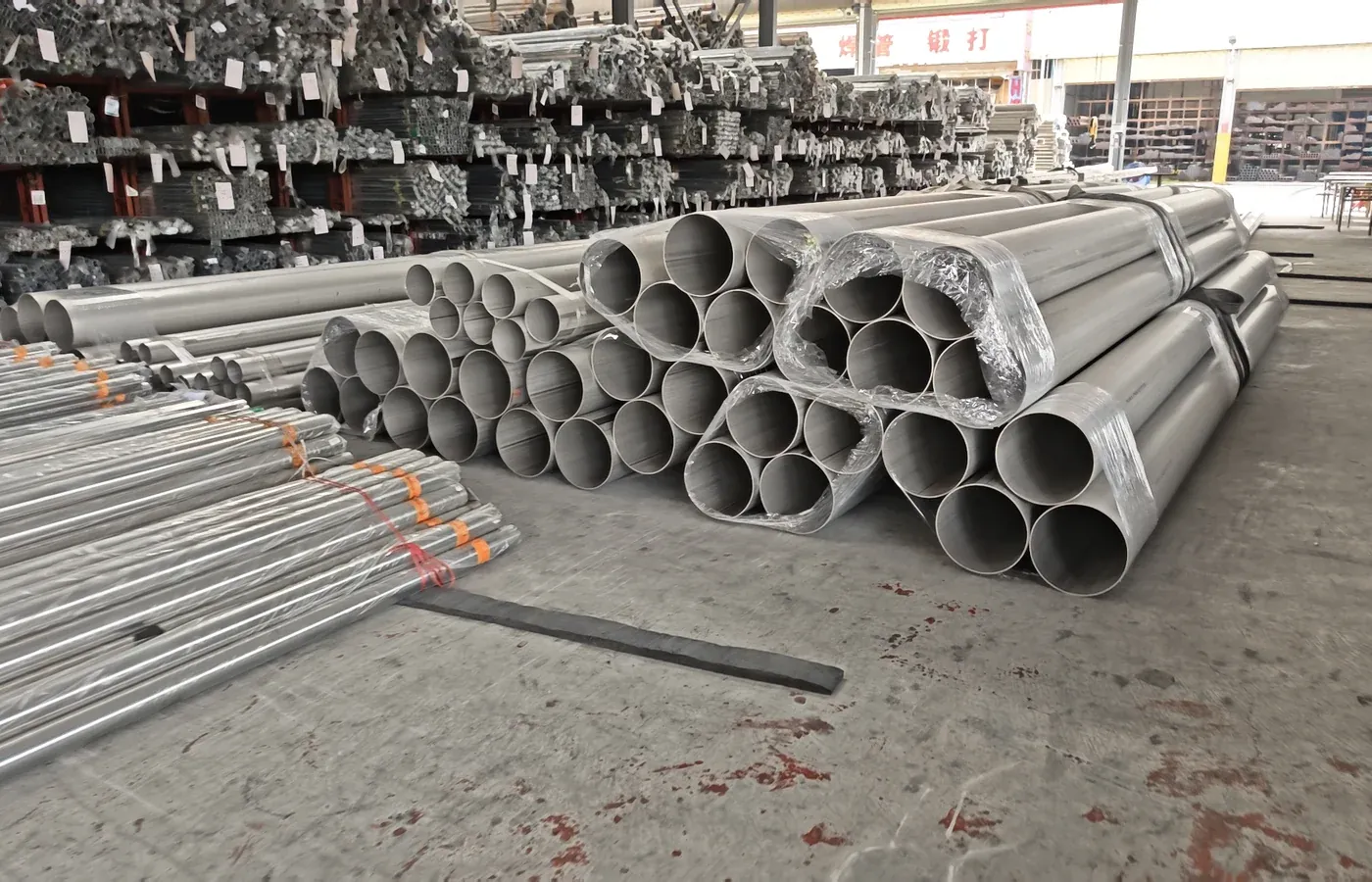
Why the standard matters more than the grade
Two pipes can share the same grade — say 316L — yet behave very differently in service. The standard you cite is what fixes the manufacturing route, heat-treatment condition, tolerances, surface state and the tests that must pass before the pipe ships. It is the contract between you and the mill.
Standards split along two lines that buyers often blur. The first is pipe vs. tube: pipe is sized by Nominal Pipe Size (NPS / DN) with a fixed outside diameter and a schedule that sets the wall, while tube is ordered by its actual outside diameter and wall thickness. The second is the delivery condition: pressure and corrosion-service products are normally solution-annealed (heat treated), whereas decorative and structural tube is often supplied as-welded. Pick the standard that matches the duty, not just the alloy. See our pipe size chart for how NPS, DN and OD relate, and our grades guide for choosing the alloy.
The standards a buyer specifies
What each of the main stainless pipe and tube standards actually covers, and the typical product it describes. Scopes summarised from the published ASTM, JIS, GB/T and EN specifications.
| Standard | Body | Scope / what it covers | Typical product |
|---|---|---|---|
| ASTM A312 / A312M | ASTM (USA) | Seamless, welded and heavily cold-worked austenitic stainless steel pipe for high-temperature and general corrosive service. Furnished heat-treated (solution annealed). | Process & pressure pipe (NPS 1/8"–30") |
| ASTM A269 / A269M | ASTM (USA) | Seamless and welded austenitic stainless steel tubing for general service at low and elevated temperatures and corrosive duty. Furnished heat-treated. | General-service tube |
| ASTM A270 / A270M | ASTM (USA) | Seamless and welded austenitic and ferritic/austenitic stainless sanitary (hygienic) tubing, with specified ID/OD surface finish. OD up to 12". | Sanitary / food & pharma tube |
| ASTM A554 | ASTM (USA) | Welded austenitic, ferritic and austenitic-ferritic duplex stainless mechanical tubing for ornamental, structural and exhaust use. Round/square/rectangular/special, to 16" OD; normally as-welded. | Decorative & structural tube |
| ASTM A778 / A778M | ASTM (USA) | Welded, unannealed austenitic stainless tubular products for low and moderate temperatures and corrosive service where heat treatment is not required for corrosion resistance. OD 3"–48". | Large-diameter unannealed pipe |
| JIS G3459 | JIS (Japan) | Stainless steel pipes for corrosion-resistant, low-temperature and high-temperature service. OD roughly 13.8–660.4 mm; grades such as SUS304TP, SUS316TP. | Industrial / process pipe |
| JIS G3448 | JIS (Japan) | Light-gauge stainless steel pipes for ordinary piping — water, hot-water and drainage — with maximum working pressure of 1 MPa. | General plumbing pipe |
| GB/T 12771 | GB (China) | Welded stainless steel pipes for fluid transport, mainly low- and medium-pressure corrosive service; covers technical requirements, test methods and inspection. | Welded fluid-transport pipe |
| GB/T 14976 | GB (China) | Seamless stainless steel pipes for fluid transport across low, medium and high-pressure systems (chemical, petroleum, food, thermal). | Seamless fluid-transport pipe |
| EN 10216-5 | EN (Europe) | Seamless stainless steel tubes for pressure purposes — technical delivery conditions. | Seamless pressure tube |
| EN 10217-7 | EN (Europe) | Welded stainless steel tubes for pressure purposes (austenitic and austenitic-ferritic) for room, low and elevated temperatures. | Welded pressure tube |
A312 vs A269 vs A270 vs A554 vs A778
The five ASTM specifications buyers confuse most often. The dividing lines are duty (pressure vs. general vs. hygienic vs. decorative), product form (pipe vs. tube), and whether the product is annealed.
Rule of thumb: if it holds pressure, specify A312 (or seamless to A269 for smaller tube); if it must be clean, specify A270; if it must look right or carry load, specify A554; if it is large-diameter low-pressure work, A778 can be the economical choice. ASME counterparts carry an "S" prefix (e.g. ASME SA312) and are used inside ASME code work.
Rough regional equivalents
Standards from different regions rarely map one-to-one — scopes, tolerances and test categories differ — but these pairings show the nearest equivalent a buyer would substitute by duty. Treat them as a starting point, then confirm the exact requirement.
| Use | ASTM / ASME | JIS | GB/T | EN |
|---|---|---|---|---|
| Seamless pressure / fluid pipe | A312 (seamless) | G3459 | 14976 | EN 10216-5 |
| Welded pressure / fluid pipe | A312 (welded) | G3459 | 12771 | EN 10217-7 |
| General-service tube | A269 | — | — | — |
| Sanitary / hygienic tube | A270 | G3447 | — | EN 10357 |
| Mechanical / structural tube | A554 | G3446 | — | EN 10296-2 |
How the same grade is named across standards
The standard fixes the product; the grade designation fixes the alloy. A grade like 304 carries a different code in each system, so an RFQ may list any of these for the same material. Designations per the respective UNS, EN 10088, JIS and GB systems.
| Common name | UNS | EN (no. / name) | JIS | GB/T |
|---|---|---|---|---|
| 304 | S30400 | 1.4301 / X5CrNi18-10 | SUS304 | 06Cr19Ni10 |
| 304L | S30403 | 1.4307 / X2CrNi18-9 | SUS304L | 022Cr19Ni10 |
| 316 | S31600 | 1.4401 / X5CrNiMo17-12-2 | SUS316 | 06Cr17Ni12Mo2 |
| 316L | S31603 | 1.4404 / X2CrNiMo17-12-2 | SUS316L | 022Cr17Ni12Mo2 |
| 321 | S32100 | 1.4541 / X6CrNiTi18-10 | SUS321 | 06Cr18Ni11Ti |
| 201 | S20100 | 1.4372 / X12CrMnNiN17-7-5 | SUS201 | 12Cr17Mn6Ni5N |
When to specify which standard
A short decision guide for the most common purchasing situations.
FAQ
What is the difference between ASTM A312, A269 and A554?
A312 covers austenitic stainless pipe (NPS-sized) for high-temperature and general corrosive service, solution annealed. A269 covers austenitic tubing (OD-sized) for general service, also heat treated. A554 covers welded mechanical tubing for ornamental, structural and exhaust use, normally supplied as-welded rather than annealed. In short: A312 for pressure pipe, A269 for general tube, A554 for decorative and structural tube.
When should I specify A270 instead of A269?
Specify A270 when the line is hygienic — food, dairy, beverage or pharmaceutical — because A270 adds controlled internal and external surface finish (commonly given as a maximum Ra) and cleanability requirements that A269 does not. A269 is for general service where surface finish is not the controlling factor.
What does ASTM A778 "unannealed" mean?
A778 covers welded austenitic stainless tubular products supplied without final solution annealing, for low and moderate temperatures and corrosive service where heat treatment is not needed for corrosion resistance. It spans 3" to 48" OD, which makes it a common, economical choice for large-diameter low-pressure pipe such as tanks and water systems.
Are ASTM, JIS, GB and EN standards interchangeable?
They are roughly equivalent by duty but never identical — composition limits, wall tolerances and test categories differ between bodies. Use a cross-reference as a starting point, then confirm the exact accept/reject criteria for your project and verify final values against the mill test certificate. ZAIHUI can manufacture to GB, ASTM/ASME, JIS, DIN or your drawings.
Products & further reading
Specify with confidence
Tell us the standard, grade, size and test requirements and we will return a clear, manufacturer-direct quotation — produced to GB, ASTM/ASME, JIS, DIN or your drawings.